

Some dogs only have to hear the car keys and they’re waiting at the door, ready for the next adventure, but for others, getting there isn’t quite so easy.
My childhood dog, Shannon, was one of those dogs. She suffered from travel sickness throughout her life. She was never actually sick, but the signs were unmistakable; lots of panting, drooling and lip licking whenever we travelled in the car and yet Shannon absolutely wanted to come with us.
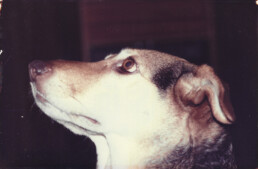
Shannon never grew out of travel sickness
Shannon was a rescue dog and, despite travelling with us regularly, her travel sickness was something she never really got over.
There were times when Mum decided it might be kinder to leave her at home rather than put her through another uncomfortable car journey.
The trouble was, we’d pull off the drive and there would be Shannon’s little face looking forlornly through the window as if to say:
Why have you left me behind?
We couldn’t bear it, and hands up it was usually it was me telling Mum, “Go back!”
So, she’d pull back onto the drive, we’d collect Shannon and off we’d all go together, travel sickness included. 🤣
Eventually, it simply became something we learned to manage. When we arrived, we’d give Shannon what we called a little “comfort break”, let her settle and, within minutes, she would be perfectly happy again and ready to join in with whatever we were doing – it was just the journey that was the problem
Going with us wasn’t!
Looking back, I think that’s an important distinction. A dog who suffers from travel sickness isn’t necessarily a dog who doesn’t enjoy going places. Shannon very much wanted to be included in family life – her body simply didn’t enjoy getting there quite as much as she did.
Of course, Shannon was just one dog and our experience was exactly that – our experience. Today we know much more about travel sickness in dogs, so what are the signs and what can owners do to make travelling easier?
Can a dog be travel sick without actually being sick?
Yes.
Vomiting is probably what most of us immediately associate with travel sickness, but a dog doesn’t have to vomit to be feeling nauseous.
According to PDSA, signs of travel sickness can include:
- drooling
- panting
- frequent swallowing
- lip licking
- retching
- vomiting
That means Shannon’s panting, excessive drooling and lip licking were themselves signs that travelling was making her feel unwell.
Some dogs can also become anxious about travelling. Shaking, whimpering, refusing to get into the car or becoming distressed before the journey has even begun can indicate that fear or anxiety has become part of the problem too.
If you’re seeing new or excessive drooling or panting outside the context of travelling, don’t simply assume it’s car sickness, as these symptoms can have other causes. Speak to your vet if you’re concerned.
Why do dogs get travel sick?
PDSA explains that motion sickness is thought to involve movement affecting the balance centre in the brain, together with the anxiety or stress some dogs experience when travelling.
It’s particularly common in puppies, although adult dogs can experience it too. Shannon would not sit down for long in the car no matter how hard we tried.
Unfortunately, feeling unwell in the car can also create an association between the car and feeling awful. A dog begins to anticipate what happened last time, becomes anxious about travelling, and that anxiety can make the experience harder still.
That’s why helping a dog become comfortable around the car can be just as important as the journey itself.
Can you help a dog become more comfortable in the car?
For dogs that are anxious about travelling, current veterinary guidance recommends building up their experience very gradually rather than beginning with a long journey.
That might start with simply spending some positive time near a stationary car.
Once they’re comfortable with that, they can progress to sitting inside with the doors open and engine off, then sitting with the doors closed or engine running, and eventually taking a very short journey.
PDSA recommends only moving on when your dog is comfortable with the previous stage and dropping back a step if they become anxious.
For some dogs, gradually building positive experiences can make an enormous difference.
But Shannon is also my reminder that not every dog follows the textbook. She travelled throughout her life and never completely lost those symptoms.
Dogs are individuals.
What can make a car journey more comfortable?
There are some practical things that may help.
Your dog should be safely restrained in the car using an appropriate harness, crate or other suitable restraint. Apart from being safer, giving them a secure, comfortable place where they aren’t sliding around may also make travelling easier.
Keeping the car cool and well ventilated is important, and on longer journeys dogs need regular opportunities for water, exercise and toilet breaks.
Food timing can matter too. PDSA’s guidance for dogs with motion sickness recommends feeding at least two to three hours before travelling rather than immediately beforehand and this goes without saying never leave your dog alone in a warm car.
When should I speak to my vet about travel sickness?
If your dog regularly shows signs of travel sickness, it’s worth discussing it with your vet rather than simply assuming it’s something you both have to live with.
Your vet can help you work out whether motion sickness, anxiety or something else may be contributing to the problem and advise you on the most appropriate way forward for your individual dog.
For dogs with severe travel sickness, vets can prescribe licensed anti-sickness medication where appropriate.
PDSA also advises against simply trying human or non-prescription travel-sickness medicines, which may be ineffective or cause side effects. Always ask your vet before giving your dog medication.
Does travel sickness mean my dog shouldn’t go anywhere?
I think Shannon taught me not to make that assumption.
For some dogs, travelling itself or arriving somewhere unfamiliar may simply be too stressful, and their welfare has to come first, but for Shannon, those two things were very different, she just didn’t enjoy the journey – She did enjoy coming with us.
If we’d decided that her travel sickness meant she should always stay behind, we’d have taken away something she very clearly wanted – being part of whatever her family was doing.
Instead, we got to know her. We knew what travelling looked like for Shannon, we knew what she needed when we arrived, and we accepted that the journey was never going to be her favourite part of the day.
What if my dog gets travel sick and I’m considering a Pawtrait Experience?
Tell me.
It’s exactly the sort of thing we can talk about during your Discovery Call before you decide whether a Pawtrait Photography Experience at my East Grinstead studio is right for your dog.
Your dog doesn’t need to arrive behaving perfectly. They don’t need to leap enthusiastically out of the car ready for their close-up either.
What matters is understanding your dog, how they travel, how they settle afterwards and what they need to feel comfortable.
Sometimes, as Shannon taught me many years ago, the journey and the destination are two very different things.
This article shares my personal experience with Shannon alongside information from UK animal welfare and veterinary sources. It isn’t a substitute for veterinary advice. If your dog experiences travel sickness, distress when travelling or any new or concerning symptoms, please speak to your vet.
Sources: PDSA guidance on car and motion sickness in dogs and safe car travel; RSPCA guidance on travelling with pets.